Walnut Limb Table
|
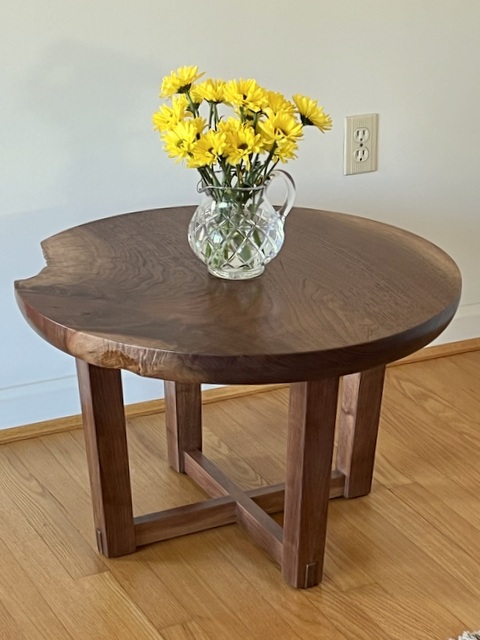
Walnut Limb Table, May 2022
In creation, a tree's reaction to the stresses on a branch is to grow areas of interlocking fibers around the joint. Such areas, while stronger, can be particularly beautiful, though less stable and often containing flaws. Hopefully, the simple, though broken, circular shape of the walnut slab top of this table displays those areas in their entirety and in an approachable visual context. With the top done, and once the design of the base was settled, thick veneers were sawn and applied to the legs with patterns that reinforce the tapers and angles of the base. May all our efforts be in concert with the work of the God of creation and worth a second look.
|
Norgaard Coffee Table
|
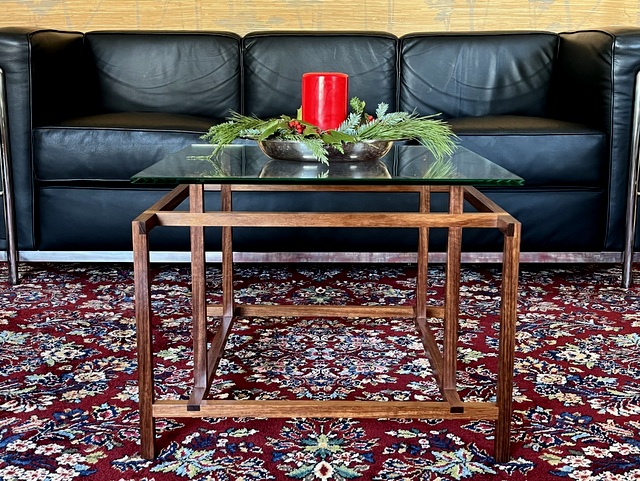
Norgaard Coffee Table, December 2021
Before TheBasementWorkshop, the need to furnish a house as well as the enjoyment of making, resulted in some initial projects. Decades ago, while browsing a Scandinavian furniture store, an elegant rosewood and glass topped table with an intriguing design was spotted. The joinery looked deceptively simple, a perfect project. But that simple joinery did not turn out so great. Good enough for a place in the living room at the time, but a disappointment. With more rosewood, better tools, and a bit of experience, this table is a remake of that copy of a coffee table designed by Henning Norgaard.
|
Emended Coat of Arms
|
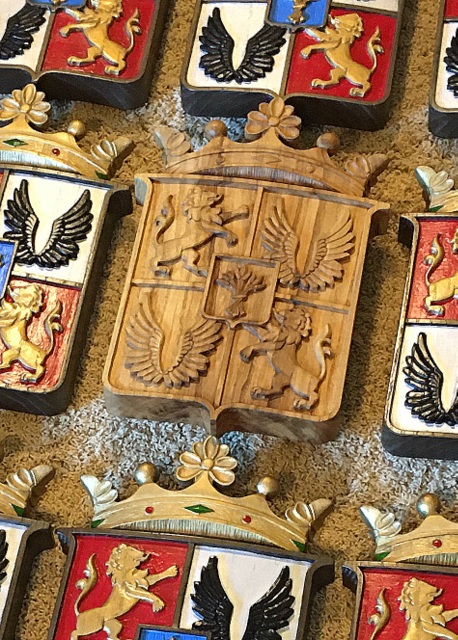
Emended Coat of Arms, May 2021
A question something like, "What are the colors of the different parts of our coat of arms?", was the basis of renewed research about the family crest. That research, done on an expansive world wide web, resulted in a downloaded copy of the entire source book that had been the reference for the image and text description of the coat of arms for the family name. That very image and text description had been passed down and used years earlier to carve the coat of arms, Coat of Arms, August 1984 to Circa 1990. Having an electronic copy of the source book revealed not only the correct colors, but a surprising discovery. The coat of arms that had been carved earlier, with castings subsequently made and distributed, was not the right one! Based on the new understanding, the correct coat of arms ought to be carved, new (colored) castings made, and those castings distributed to the extended family. As Kipling said, "Nothing is ever settled until it's settled right."
Happily, just enough Chinese chestnut wood remained from the tree cut decades earlier at the family home and used in the first carving, the Coat of Arms, August 1984 to Circa 1990, to carve another, a correct, an Emended Coat of Arms, May 2021.
|
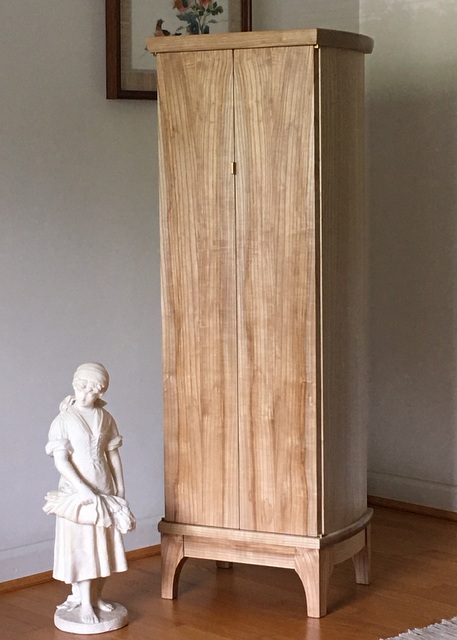
Tall Ash Cabinet
|
Tall Ash Cabinet, August 2020
This cabinet was made from a section of an unusually long, wide, and thick plank of straight, mostly clear, old ash that was found more than four decades ago. The impressive dimensions of the plank informed the design of the cabinet; somehow the mass of the plank needed to be reflected in the cabinet. When the heartwood section of the plank was resawn on the bandsaw, darker brown color and patterned boards were produced. Those boards were matched and utilized for the doors and the back assemblies of the cabinet. The boards from the sapwood sections were creamy white with tighter grain lines. They were matched, cut into strips, and coopered into curved sides. The top and bottom, shelves, and parts for the base all came from the same section of the massive plank. Assembled with some glued and some floating splines, as well as dowels, this solid wood cabinet is in fact heavy. The hope though is that somehow the cabinet both reflects the mass of the plank that it came from and yet finds a lightness in its precision and simple lines.
|
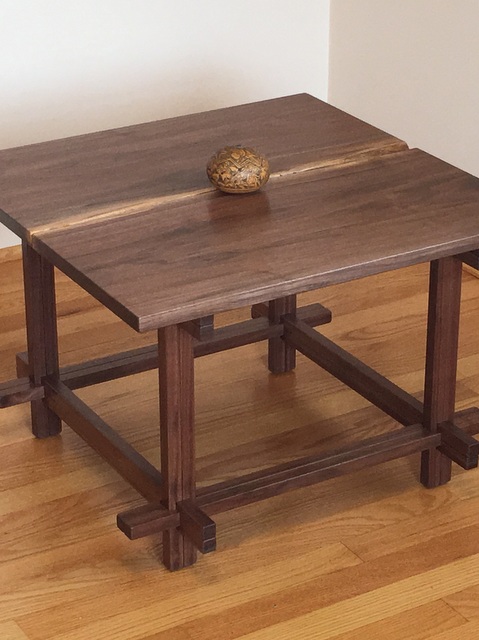
Walnut Puzzle Coffee Table
|
Walnut Puzzle Coffee Table, March 2019
The design of this table began with two pieces of walnut with an unusual range of color. Together they were about the right size for the table top, yet finding some balance between the two non-symmetrical pieces presented a challenge.
Once the balance of the top was addressed, to promote balance in the overall piece, a very ordered base seemed fitting, a base with each leg employing a six timber joint.
Finally I am happy that this table is in the home of a craftsman whom I admire, and whose work is always in the 90's.
|
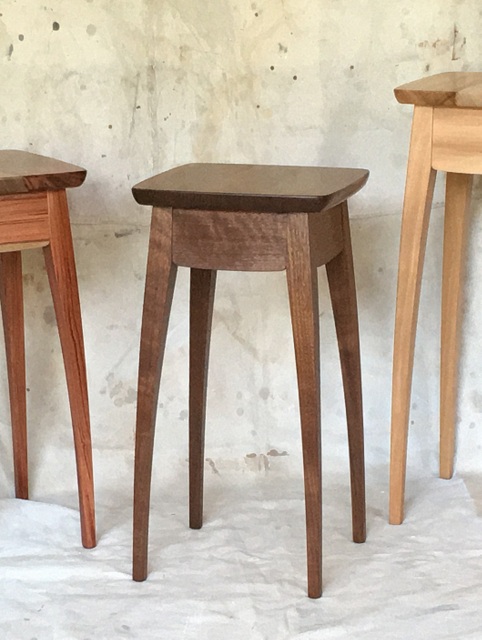
Cup of Coffee Tables
|
Cup of Coffee Tables, May 2018
A relaxed person in a chair, a cup of coffee on a coaster, and some time to read and think, that is the scene that was imagined when this little "Cup of Coffee" table was initially conceived. The first table was made of walnut for a Poang Chair. When the prototype legs were propped up next to the chair, it was instantly obvious that the table would be too high by about four inches. In addition to a change in the length of the legs, the simple shortening would require a more slender leg with appropriately modified curves, as well as a narrowed apron. A second table of the same height was then made of bubinga for an Eames Lounge Chair. Finally a third table, of the original height, was made of sycamore for a Hans Wegner Shaker Rocking Chair. It is interesting how the form of both shorter tables has a different "feel" than the only slightly different taller table. How does each of the two forms "feel" to you?
|
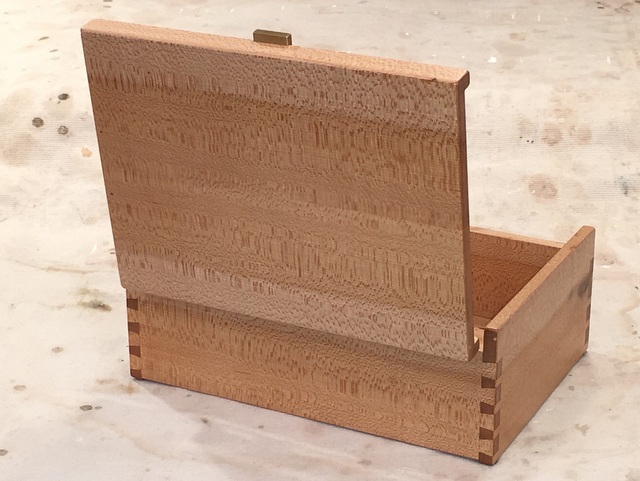
Quartersawn Maple Box
|
Quartersawn Maple Box, March 2017
From some now forgotten source, came an old fencepost cut from hard maple, fortuitously and exactly quartersawn. Too good to throw away, yet filled with worm holes, splits, and rusty nails, the figure made the post unfit for the fireplace. Though some small flaws in the wood could not be avoided, enough wood was salvaged for this crisp little box. Perhaps the flaws are an interesting contrast to the very elegant figure of the maple.
|
Large Dovetail Pieces
|
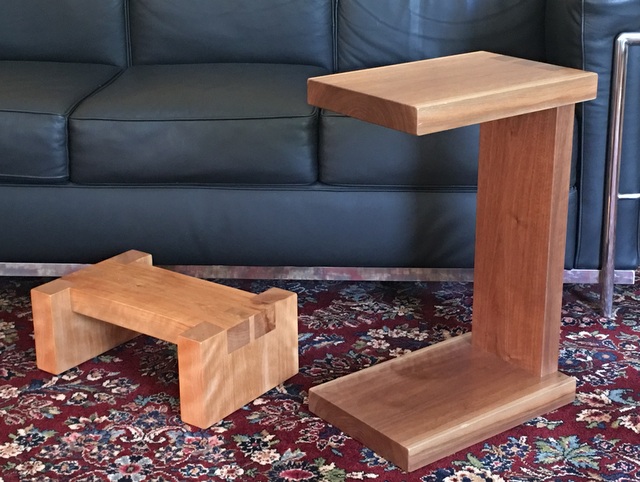
Large Dovetail Pieces, July 2016
A project, not yet built, includes large dovetails, a challenge to be mastered. At the same time, a small night table was needed as an addition to a walnut bedroom suit of Scandinavian design. These two considerations resulted in a couple of experimental pieces with large dovetails central to their simple, square, and austere design.
|
Box for a Haiku Poet
|
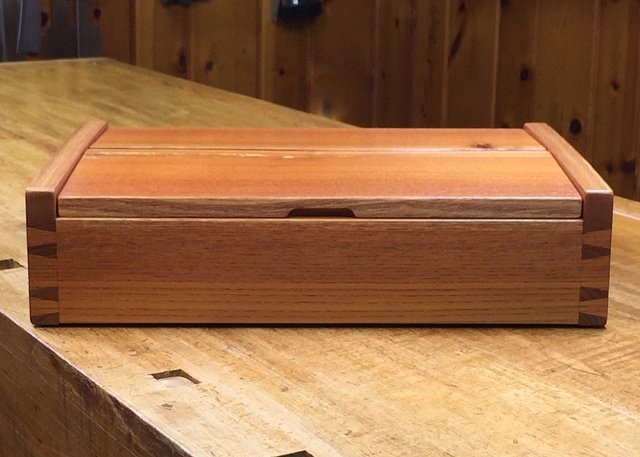
Box for a Haiku Poet, February 2015
This piece was made to express gratitude to a friend that writes haiku.
late evening
dust from sanding one side
smooth
Gary Hotham
|
Six Timber Joint
|
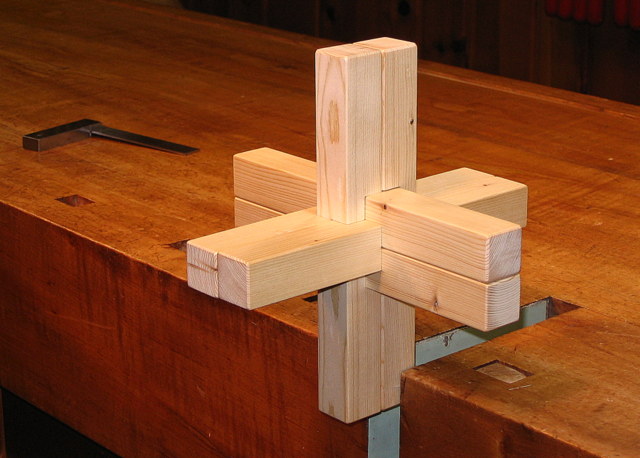
Six Timber Joint, December 2013, March 2016
While working on the design of a shelf for cutoffs, this joint which had always fascinated, was rediscovered. Now sufficiently intrigued, it was fashioned from a piece of 2x4. The simple shelf is done, the joint investigated not used.
|
Chinese Cedar Recipe Box
|
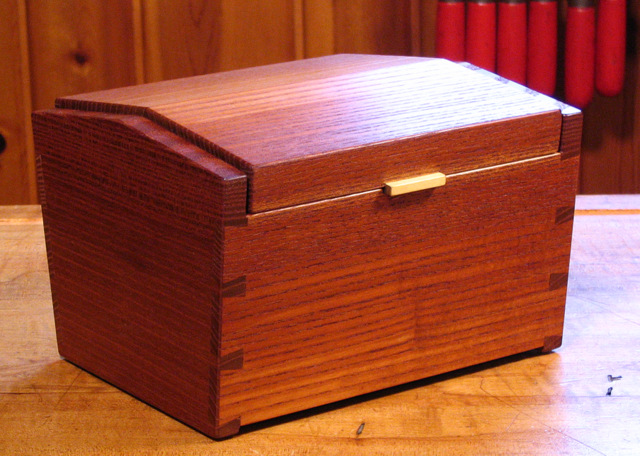
Chinese Cedar Recipe Box, October 2012
Chinese Cedar is a ring porous wood. This recipe box was cut from a plank where those distinct annual rings became gradually tighter and whose color darkened, (from a golden reddish brown to a reddish brown), as the rings became closer at the edge. These gradual changes in the wood were to be complimented by the shape of the box. The grain lines narrow up the front of the box, are narrow to broad from the start of the lid to the peak, then matched, broad to narrow from the peak to back edge of the lid, and then narrow to broad down the back. The angularity of the form also allows for flipping of the recipe cards within an accommodating dovetailed divider. Finally, a small brass handle was made to match the brass hinges and finalize the design.
|
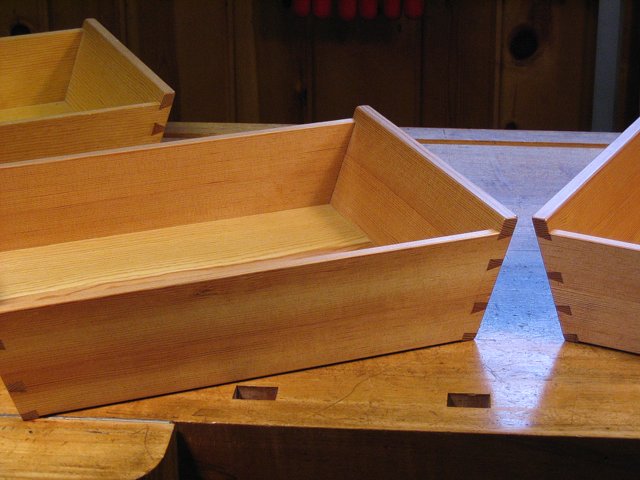
Pine To Do Boxes
|
Pine To Do Boxes, Circa 1995 and August 2012
These boxes are made to hold those papers that define what we need to do. The shape of the boxes is to accommodate reaching for a paper somewhere in a stack of various papers and folders. The hope is that as the next chore is retrieved, the angled ends will give a sense that someone has been considerate. The first box was made years ago when there wasn't much opportunity for time in the workshop. The two newer boxes provided a means for getting reacquainted with the shop and for sharing with a friend how to pursue a simple piece.
|
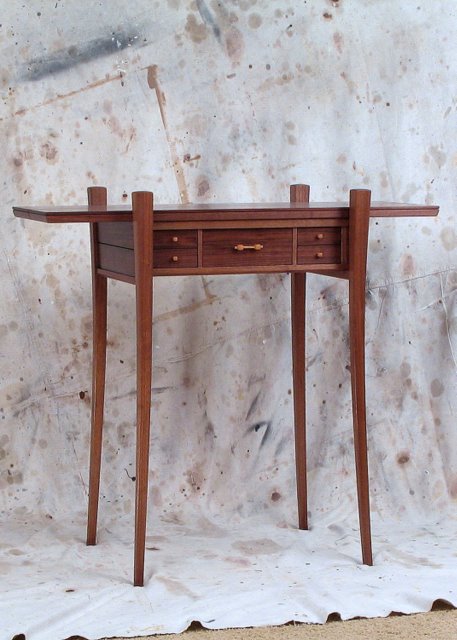
Walnut Hall Table
|
Walnut Hall Table, April 2011
The factors that should affect the design of any piece of wood furniture include purpose, form, wood selection, construction, and detail. From the outset, this table was envisioned around people in a foyer or hall, demanding a certain height and width for presence and yet a relatively shallow depth. Sketching resulted in a proud leg, intersecting a strong horizontal top, combined with a relatively diminutive case. The use of boldly striped walnut for the top, reinforced the strong horizontal, while the wood for the legs and various case parts were chosen so that the darker walnut drawer fronts, sides, and back rails are framed by lighter walnut. Joining the sides to the legs would require a too long mortise and tenon joint that over time would expand too much, so a spline was incorporated into the sides as well as into the top and back rail to halve their sizes. And finally, as in any piece there are numerous choices regarding the treatment of edges, reveals, pulls, and finish.
|
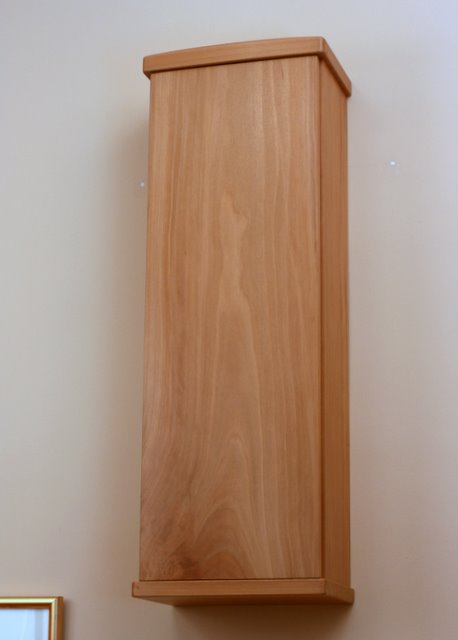
Sycamore Cabinet
|
Sycamore Cabinet, February 2011
The sycamore for this cabinet was harvested in October of 1981 from the city streets of northwest Washington, DC using a two person chainsaw mill. The plank that was used, located about halfway from the center of the log, displayed a delicate wispy flame pattern. The door for the cabinet was sized and planed to a very slight curve in order to highlight the subtle pattern. Suitable sides, a curve in the top piece, and a doweled carcass were chosen to further complement the flame. The pattern of the back panel echoes the door having been cut from the same piece of plank. The result is a straightforward cabinet that strives to exhibit the easily overlooked beauty of this native wood.
|
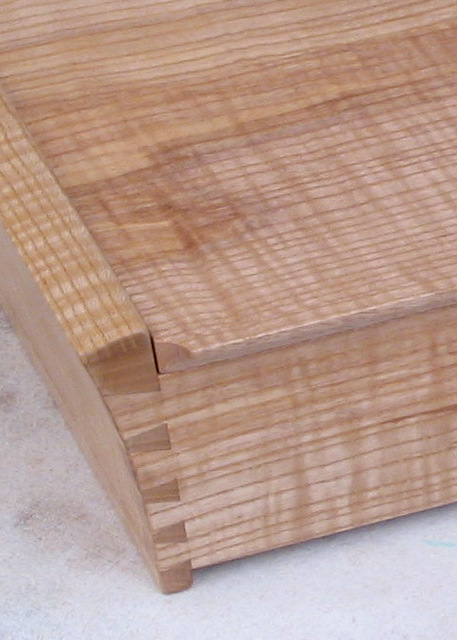
Ash Bible Box
|
Ash Bible Box, August 2010
This box was made from a blond, highly figured ash billet and a couple of chunks of ash leftover from a cabinet made years ago. The billet was resawn into boards for the top and bottom panel, and the chunks were resawn into pieces for the front, back, and sides of the box. Though pairs of book matched pieces were produced, the decision was made to arrange the pieces into a freer, though balanced, pattern of dark heartwood and light sapwood, rather then using the earlier anticipated approach of book matching. Once these decisions were made another element was developed, the angled curved profiled sides that are joined to the front and back with graduated dovetails. The final design element that emerged was the integrated handle with its' notched ends.
|
Bubinga Stand
|
Bubinga Stand, July 2010
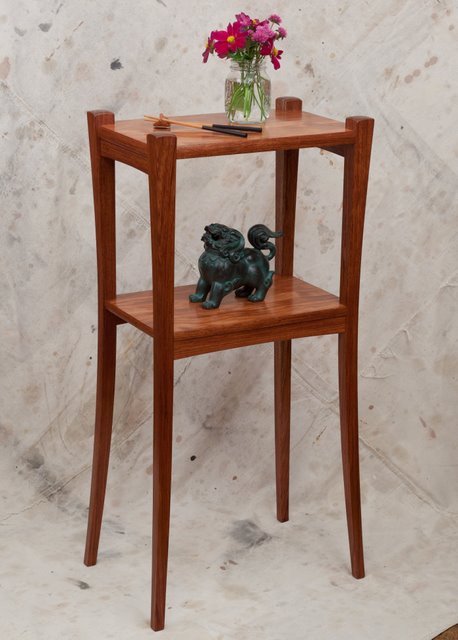
Design is sometimes an unpredictable process. The idea for these legs was actually developed in the context of another piece. But as that piece progressed, these legs proved to be too much for it and they were set aside with the determination to create a stand using them as the central design feature. Note the outside lines that sweep up from the floor to sculptured top and the inside lines that follow the outside lines to the middle shelf and then blend into straight, vertical lines that define the inside of the display area. To complement the strong, active lines of the legs, wood with whorling grain patterns was chosen for the shelves that were then let into the legs at the corners. And finally the design for the stand was completed with curved and tapered stretchers using double mortise and tenon joints.
|
Walnut Baptismal Stand
|
Walnut Baptismal Stand, May 1983, Restored April 2010
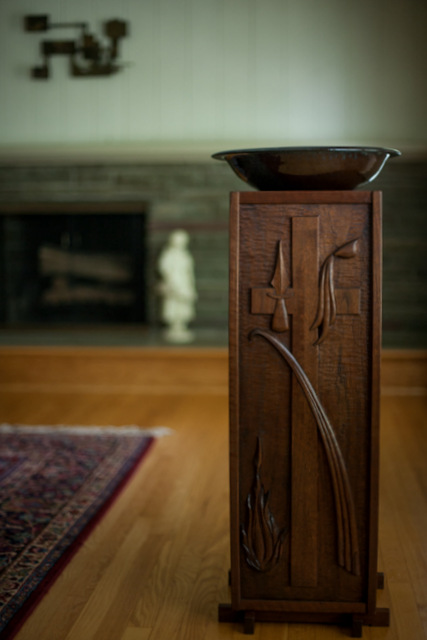
The front panel of this baptismal stand is carved with symbols of the Covenant of Grace. The fire remembers the covenant made with Abraham when a blazing torch passed between halved sacrifices. Abraham also received circumcision, the Old Testament precursor to baptism, represented in the carving by a knife. The waters of baptism appear in the upper right, while sweeping across the panel is a rainbow, the reminder given to Noah and all mankind that God would never again destroy all life through a flood. The inside of the baptismal bowl, designed and thrown by a potter friend, is glazed blue for water, with a blood red slash. And finally the cross, centered on the panel, is there as a reminder of the death of Jesus for the forgiveness of sins, the price paid to keep the promise to make a people His own.
Originally commissioned in 1983, the stand suffered damage while in storage, necessitating a renovation. Given the chance to work on the stand again, the opportunity was taken to re-carve the rainbow which had been something of a disappointment. The tools used years ago were taken up to fair the curves, improve the shape of the end in the foreground, and to add spectral bands. It was satisfying to fix something that wasn't quite right.
In June 2012 a new bowl to replace a broken one was let into the top of the stand.
|
Cherry Chiffonier
|
Cherry Chiffonier, March 2010
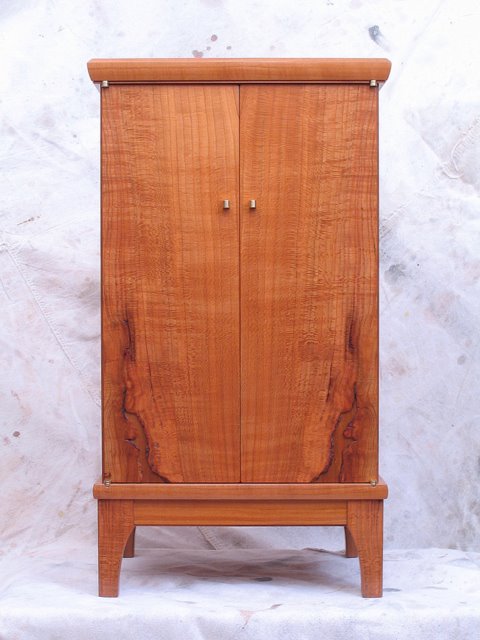
To design from the wood seems to raise in some the idea that the shape of the design is somehow related to the shape of the board. This cabinet may illustrate another way to design from the wood, where the character of the design reflects the character of the wood. This chiffonier is primarily constructed from two pieces of wood, a large billet, from which cores were sawn, and a smallish flitch. Both were cherry and both to some degree quartersawn. Quartersawing is a technique that yields pieces whose annual rings are nearly perpendicular to the surface of the wood. This results in stable pieces with surfaces that may be marked by flecks or rays in addition to the regular markings in wood. The long treasured cherry flitch used in this piece was an unusually excellent example of quartersawn cherry both in color and in the prominence and pervasiveness of flecks and rays. So to design from this piece of wood meant to stretch that flitch by sawing it into thick one eighth of an inch veneers and using them to cover all of the surfaces of a design that promoted the elegantly marked wood.
|
Walnut Fork Knitting-Sewing Table
|
Walnut Fork Knitting-Sewing Table, June 2009
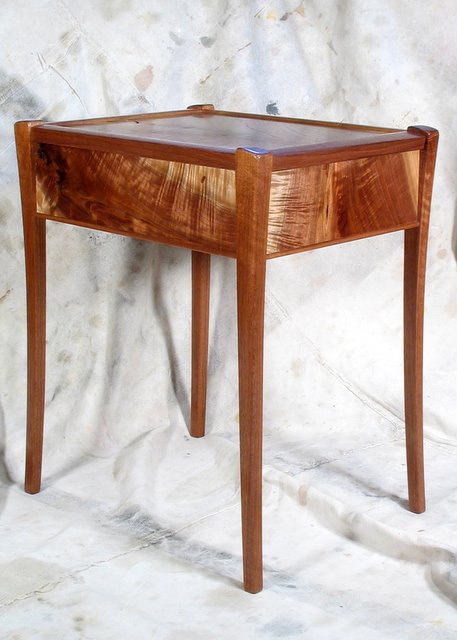
The plank for this table was taken from a walnut tree that forked as it grew, reaching for sunlight. Internal forces born in that fork, caused the wood to knit together for added strength. That knitting resulted in wood with a beautiful shimmer, striking features, and that split as it dried. Work on the table began by cutting a solid top out of the fork in the plank. Next a sample leg was developed so that the piece could be mocked-up in three dimensions. During the mock-up, another major feature of the design emerged. Overlays were cut so that all four sides looked as if they had been unfolded from the top.
As is often the case with exceptional wood that results from stresses in a tree, the challenge is to include it in a piece that has sound construction and a refined look. Time will tell if the construction is sound and hopefully the design is refined enough for this dramatic piece of wood.
|
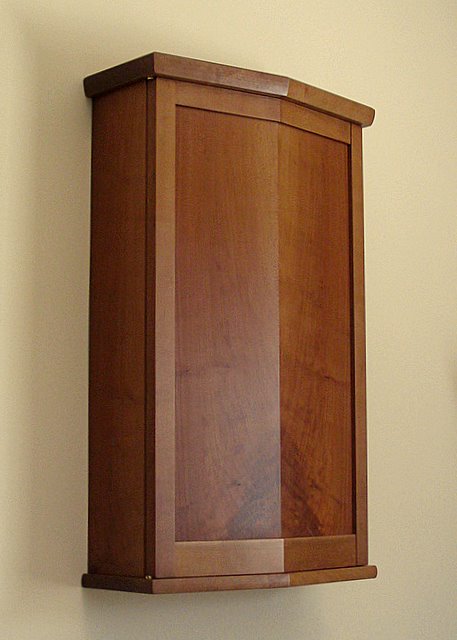
Cherry Cabinet With Angled Door
|
Cherry Cabinet With Angled Door, Circa 1983-March 2009
This cabinet was designed and the pieces were rough cut from a cherry plank more than twenty-five years ago. The original design called for two paneled doors that were angled and met in the center. But during the process of examining the two panels, and turning them this way and that and then one way and then another, a better solution emerged -- a single door with an angled panel. This approach better showed the subtle book match of the panel pieces because they were not separated by frame pieces running down the center between the two halves. Once the door was settled the rest flowed quickly, if quickly can be used at all, in relation to a cabinet that took more than twenty-five years to complete.
|
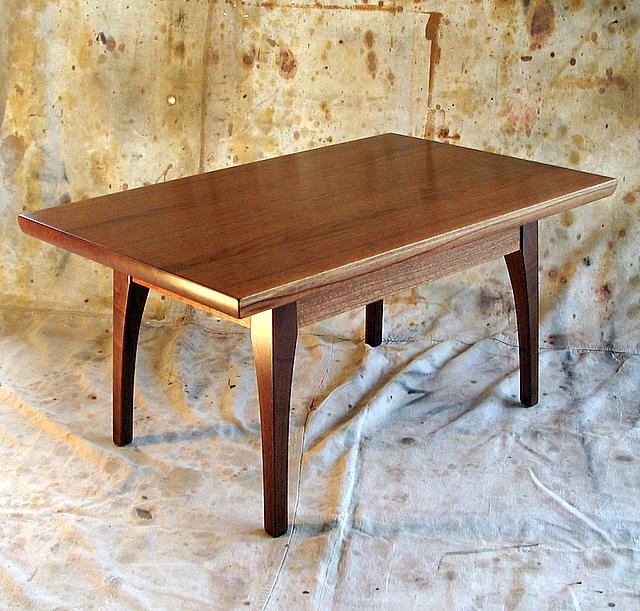
Siloam Walnut Coffee Table
|
Siloam Walnut Coffee Table, September 2008
The wood for this table comes from a friend's beloved property in Pennsylvania that he called Siloam. With the help of another friend, it was cut and then slabbed with a chainsaw mill. About fourteen years ago, after the wood had dried for years, a third friend wanted a table to give as a gift. In the early stages of design, some of that wood was cut and glued up as two table halves. Never used, those rediscovered halves became the starting point for the design of this table. When glued into a single top, there are two pairs of bookmatched boards with a board from each pair in each half, and the whole composed to look like a single bookmatched pair. The base to the table is designed to be upright to complement the spacious top. The legs are overlaid with thick veneer, cut from the same board as their cores, so that all of the leg faces match and follow the curve of the legs.
|
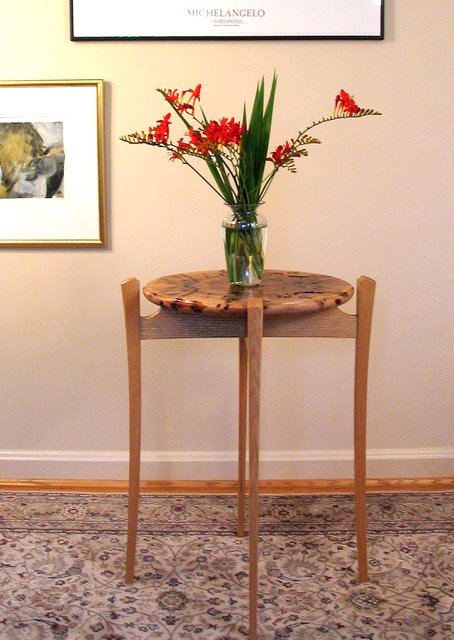
Oak Burl Tea Table
|
Oak Burl Tea Table, May 2008
Work on this table began with a desire to use a large oak burl of unremembered origin. Once the modestly sized slabs for the top were sawn from the burl they displayed compelling features and patterns. A nice burl top had been the inspiration for a previous tea table. The project album listed below and entitled Tea Table contains a few pictures of the table made around 1978. The design for this Oak Burl Tea Table grew from the previous Tea Table design and that table was in turn inspired by a table in A Cabinetmakers Notebook. This latest table has long legs set on the axes of the elliptical top to highlight the bookmatch in the burl top and the slender shaping of the legs.
|
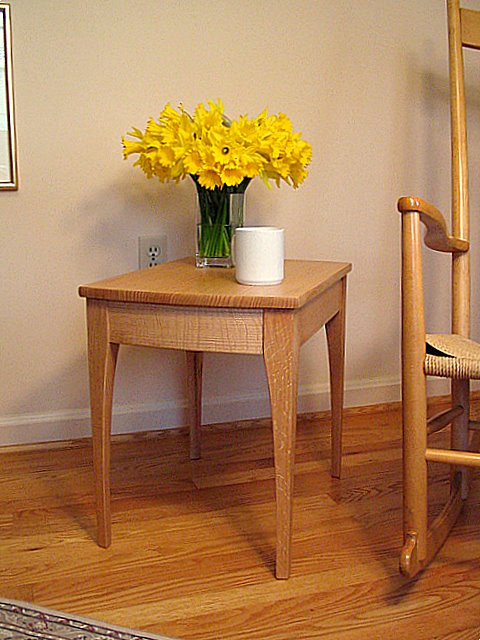
Oak Reading Table
|
Oak Reading Table, March 2008
The wood for this table comes from a Black Oak log that was harvested with a chain saw mill decades ago. While drying the planks twisted and cracked badly. When the piece for the top was cut and milled the stock showed a shimmering quarter figure and a disappointing discoloration from obscure stains where stickers had been placed between the planks while the wood cured. Through much sawing, resawing, applying, and laminating the quarter figure is featured throughout the table while the discoloration has been eliminated.
|
Mahogany Reading Table
|
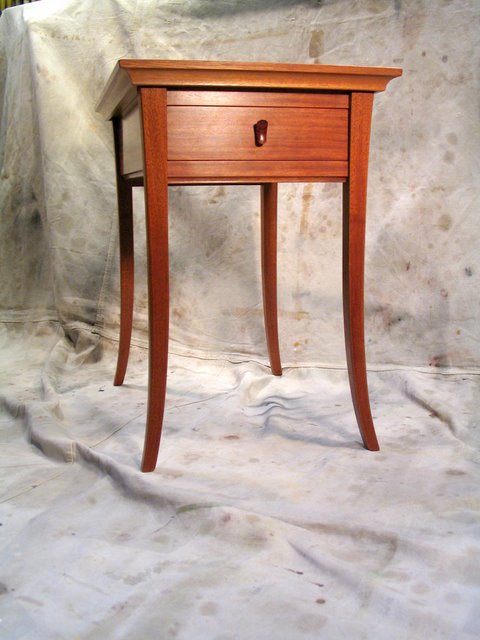
Mahogany Reading Table, November 2007
A visit many years ago to the home of an old German cabinetmaker ended with his gift of a perfect, yet small, plank of Cuban mahogany. Years after that another friend inquired about commissioning a coffee table. Partially designed, it was never made due to responsibilities other than work in the basement workshop. This mahogany reading table grew out of those events. The curve of the leg is an adaptation from the coffee table design and the Cuban mahogany was overlaid on the top and sides. African mahogany was used for the legs, with spalted bubinga for the drawer sides.
|
Pulpit and Communion Table
|
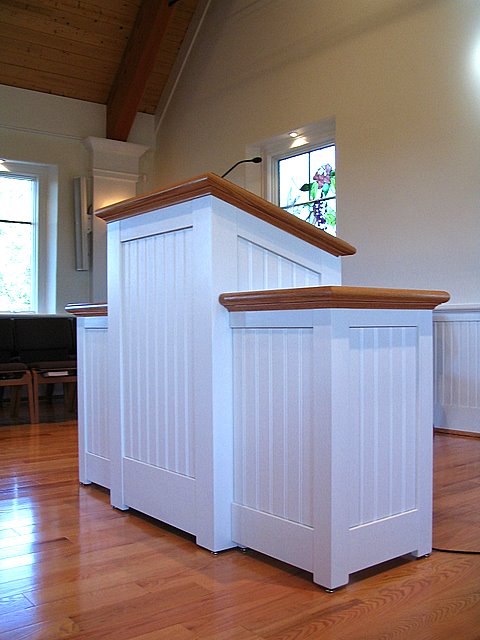
Pulpit and Communion Table, May 2007
"How, then, can they call on the one they have not believed in? And how can they believe in the one of whom they have not heard? And how can they hear without someone preaching to them? And how can they preach unless they are sent? As it is written, 'How beautiful are the feet of those who bring good news!'" Romans 10:14-15
Hopefully this pulpit will adorn the feet of those that bring good news and thereby bring glory to the One who is the good news.
|
Maple Burl Bible Box
|
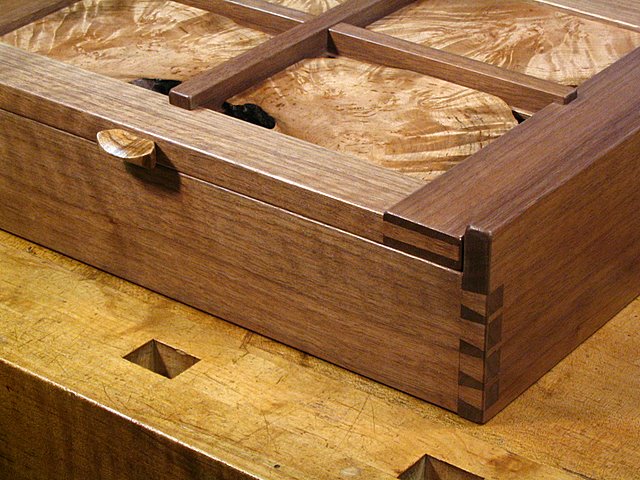
Maple Burl Bible Box, January 2007
Nearly twenty-five years ago when the benches for the basement workshop were made, all of the maple in them came from a single log of Ambrosia maple. Some of the planks shared a burl that had grown near the butt of that tree. Unsuitable for bench construction, they were trimmed off of the planks and laid aside. Recently while browsing through medieval flags, the idea developed of making a Bible box with a lid that reflected the flags' motif of a field divided by a cross. That motif executed with some of the burled Ambrosia maple as the field became the basis for the design of this box.
|
Fir Cross
|
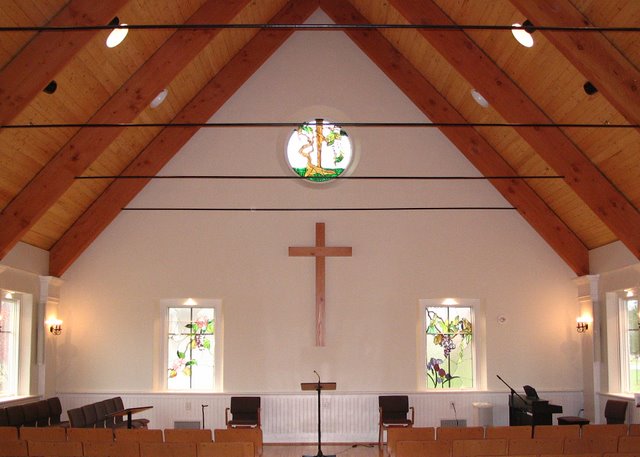
Fir Cross, October 2006
This cross was made to go in the sanctuary of the recently completed Good Hope Presbyterian Church. It was made refined enough to be seen as symbol not facsimile and yet heavy and large enough to recall the historic event for which it is a symbol. "Carrying his own cross, he went out to the place of the Skull (which in Aramaic is called Golgotha). Here they crucified him, and with him two others--one on each side and Jesus in the middle." John 19:17-18
|
Canticles Bible Box
|
Canticles Bible Box, July 2006
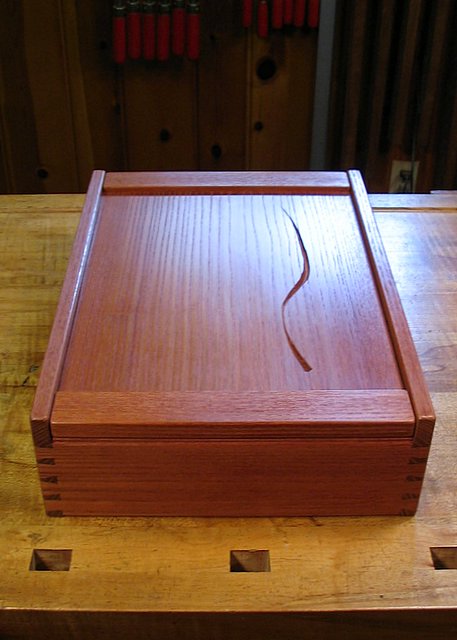
Often the Song of Songs is interpreted as an allegory of the relationship between Christ and His Church. But for some the poetic language is more indicative of married love as created by God. Intending to reflect that view in the design of a Bible box, the hip waist curve of a woman was sketched. For that curve to be carved into the top, a panel with straight grain was needed to complement the carving. Once that panel was made, the pattern for the simple carving was copied, glued to the panel, and then executed. With the panel done, the design for the rest of the box could be finalized. Keeping the top in mind, the wood for the remaining pieces was selected, the overall dimensions settled, and construction details designed. Everything about the box is straight and regular so that the distinctive waist hip curve is emphasized.
|
Chinese Cedar Bible Box
|
Chinese Cedar Bible Box, May 2006
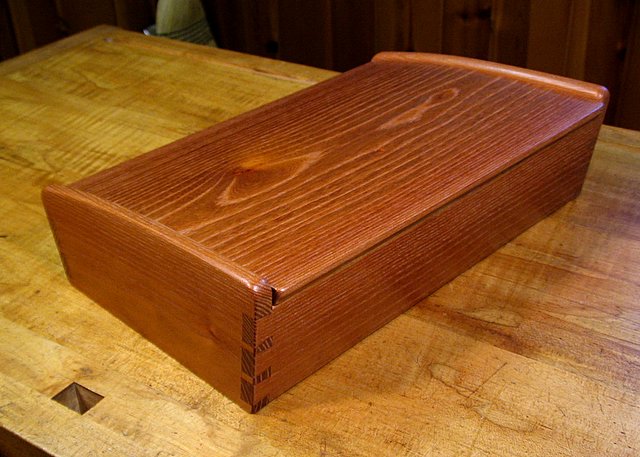
The initial impulse for this box included the idea of a lid that curved asymmetrically. The curve was intended to emphasize the way annual ring patterns vary in spacing across the width of a flitch. Sketching began by drawing the end view. The end view illustrated the curve of the lid and sides that vary in height and angle to complement that curve. The top view included a simple carving in the lid, but when the piece of wood that would be used for it was identified, it contained a strong and graceful grain pattern resembling the carving. So the box was executed with the grain pattern replacing the simple carving as the focal point of the lid.
|
Siloam Walnut Bible Box
|
Siloam Walnut Bible Box, April 2006
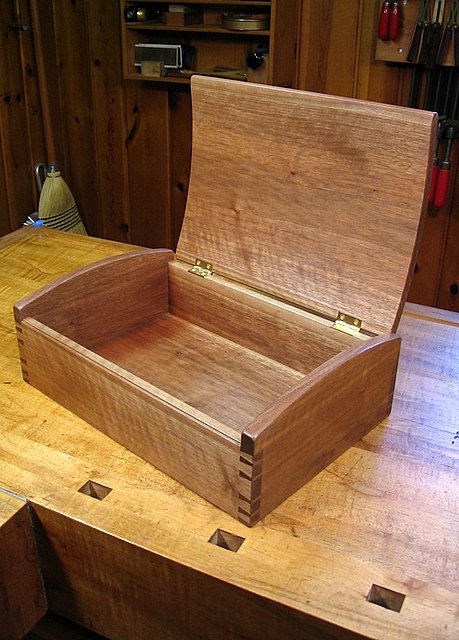
When this project began there were two motivating impulses. The first motivation was a Bible box that was made thirty years ago. That Bible box has a folk design carved into the front. The second motivation was the desire to make a box that was serene in mood. To develop the design the original Bible box was studied and rubbings were taken off of the carvings. Several sketches were then produced resulting in improved patterns for the carvings and a simple box with a solid coopered lid. The wood was then determined and construction of the lid undertaken. Sometime during construction of the lid and the subsequent selection and preparation of the wood for the sides the vision for this box sorted out. The carving would be a distraction. This box would feature the subtlety of the Siloam walnut and the graceful coopered lid. That would be enough. The carving will be done on another box.
|
Dogwood and Hickory Bible Box
|
Dogwood and Hickory Bible Box, February 2006
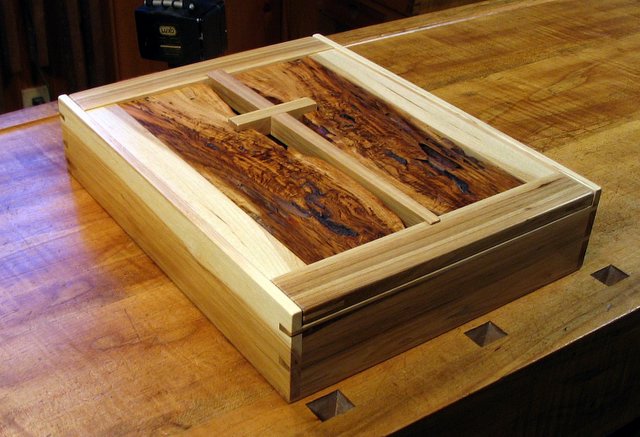
In earlier times all books, and particularly the family Bible, were precious. Sometimes the Bible was kept in a box to protect it. This Bible box began with a small billet of dogwood. Though wormy at the core, the wood was beautifully figured. After the panels were cut for the top and then arranged, studied, and rearranged, it seemed appropriate to frame the panels with a cross that was as perfect and as sound as possible. Hickory was matched with the dogwood and was used for the rest of the box. Though a pleasing combination, the hickory was very tough on tools and hard to work with.
|
Finn Juhl Bwana Chair
|
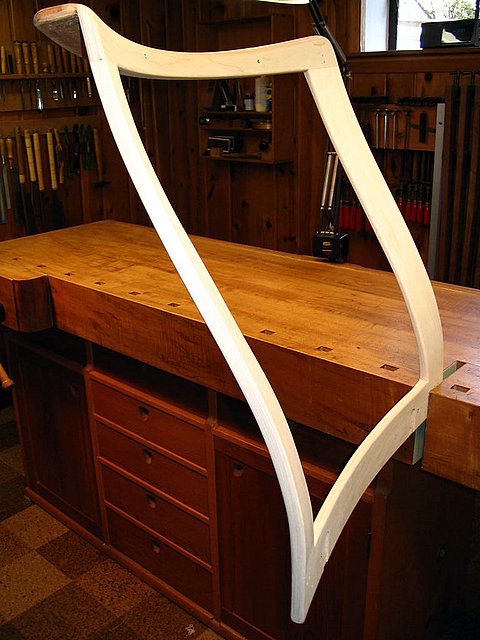
Finn Juhl Bwana Chair, January 2006
A generous friend gave us this Bwana chair, a matching ottoman, and a coffee table. They were all designed by Finn Juhl and executed in teak. In addition, she gave us a teak rocking chair designed by Ole Wanscher. The furniture was to be reupholstered and become the seating group in a new study. But closer inspection and disassembly revealed that each piece would demand significant reconstruction. The Bwana chair needed the knob joinery remade and it also needed a complete set of new upholstery frames constructed before it could be reupholstered. Rebuilding and reupholstering these classics proved to be a rewarding experience. It was like sitting under the tutelage of these fine designers.
|
Ole Wanscher Rocker
|
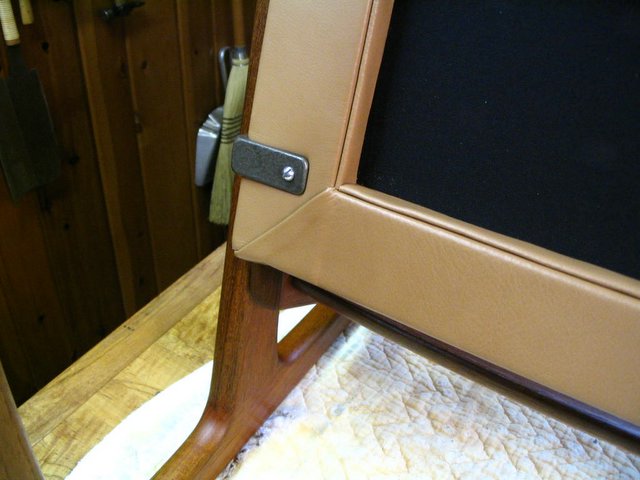
Ole Wanscher Rocker, February 2005
This rocker arrived with a surprise under the seat cushion. The original frame and suspension system had been replaced by a piece of three quarter inch plywood. What's more, the geometry of the chair (at least with its plywood seat) was not comfortable. Therefore, the restoration process began with an experiment. Using a jig to hold the back of the seat at various angles, the position of the bottom was tested by sitting on it. Once the best angle was found, work could begin.
|
Handled Toolbox
|
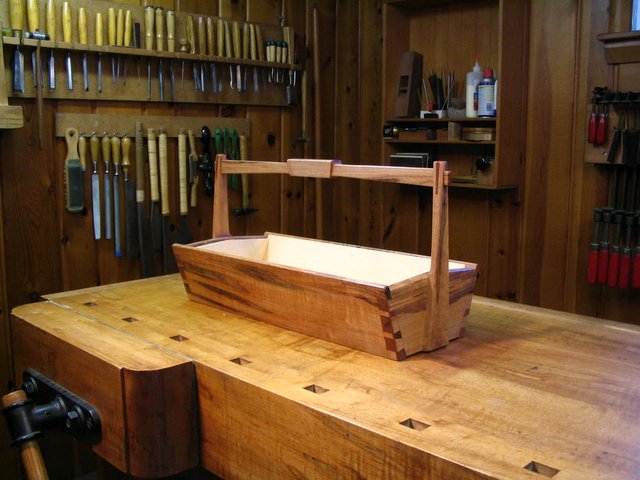
Handled Toolbox, December 2004
The inspiration for this handled toolbox came during a meeting. Intrigued by the construction detail of attaching a handle to a box, from the first sketch the central design element of this project was the long sliding dovetail along the side of the box. The angled and tapered sides of the box, the sculptured shape of the handle's crosspiece, and the undercut of the handle's side pieces are design details that were developed along the way to complement the joint that connects the handle to the box. Once the box was completed, it seemed harsh to just throw the tools in, so a pine liner was made to protect the box itself.
|
Finn Juhl Bwana Ottoman
|
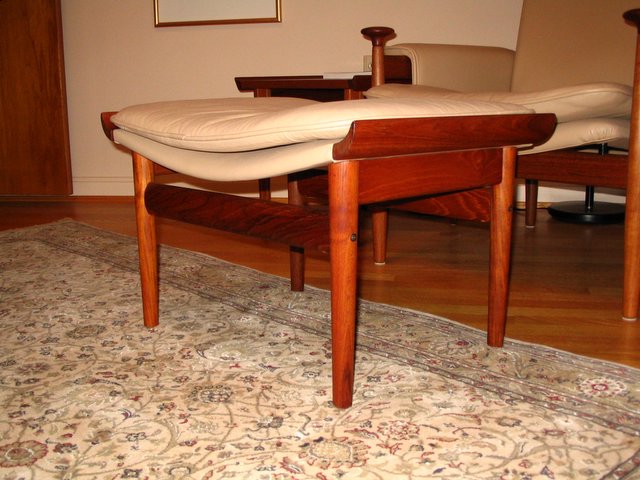
Finn Juhl Bwana Ottoman, November 2004
The restoration of this ottoman posed an interesting challenge. The seat frame, which had originally been made in an industrial sized hydraulic press, was completely delaminated and a new one would have to be made. But the bigger challenge was what to use for the suspension within the frame. Flattened springs had provided the suspension for the original framework. Those springs looked like screen door springs that had been run over. Though nothing like them could be found, elastic webbing was used and, at least so far, seems like a good substitute
|
Finn Juhl Table
|
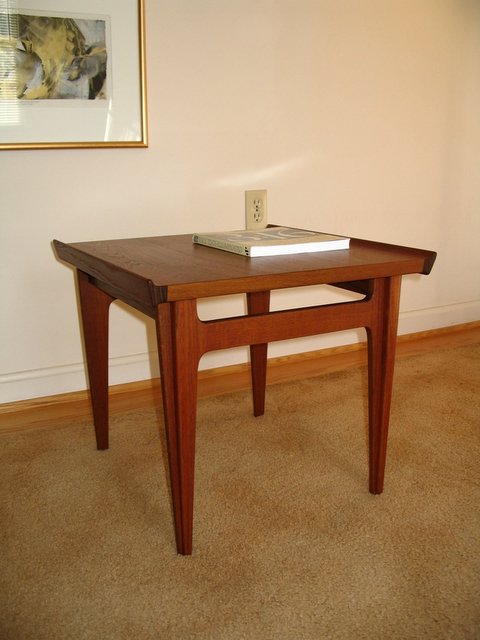
Finn Juhl Table, November 2004
This table is a rebuilt Finn Juhl coffee table. It was originally about one and a half times longer and wider than it is now. When received from a friend, it had a lot of wear and the moldings along the edges were badly broken. To salvage the table, the moldings were rip-cut off and then cut to the longest possible undamaged lengths. The veneered field of the top was recut to match the new molding length while maintaining the original proportions between length and width. Finally, the base was cut apart and rebuilt to match the newly sized top. Though not intending any disrespect to Mr. Juhl, the top was rotated 90 degrees when reassembling it to the base.
|
Walnut Stump Slab Table
|
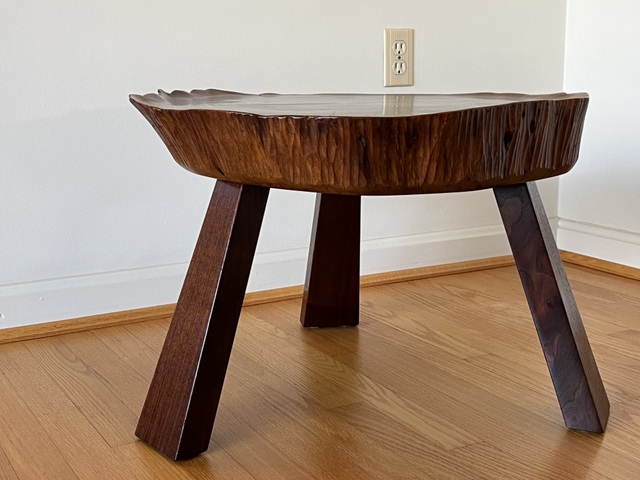
Walnut Stump Slab Table, Circa 1993
The slab used as the top of this coffee table was discovered by a kind friend, discarded in the woods. Found in 1976, it was roughly shaped into the top the following year. While flattening it, the idea to pie-crust the edge of the naturally shaped top emerged. Pie-crusting it would mean forming it so that the flat surface would flare up at the edges. Due to the demands of life, once initially shaped, the top was not finished and made into a coffee table for almost twenty years.
|
Coat of Arms
|
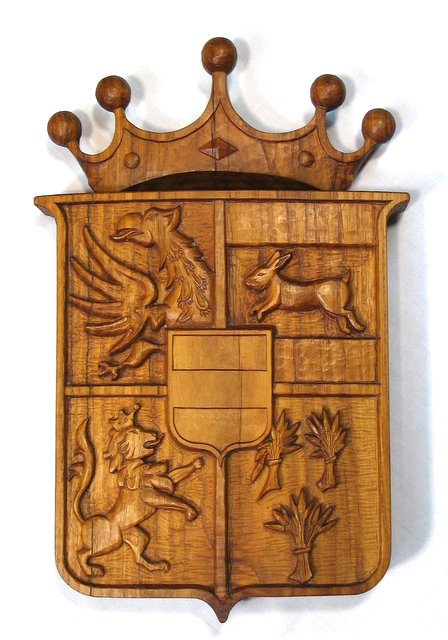
Coat of Arms, August 1984 to Circa 1990
The wood for this family coat of arms was cut from a plank of a Chinese chestnut tree. Though not a particularly good wood for carving, it was used because my father had grown the tree at the family home. Harvested at a time when work in The Basement Workshop was being set aside, the wood seasoned for a few years and was carved intermittently over the course of yet a few more years. Eventually, the original was used to have castings produced for the extended family.
Careful observation of The Basement Workshop webpage will reveal an almost twenty-five year gap between early work and later work. During that gap only this coat of arms appears on the webpage. Why the gap? The responsibilities of life seemed to demand a more secure calling than speculative woodworking. And graciously, Providence provided that calling.
While the coat of arms was granted to the family name years ago, this carving has become a reminder of family blessings and fleeting time. Thankful to be back at work in The Basement Workshop, this coat of arms also reminds of the gracious Lord's command, "Seek first his kingdom and his righteousness, and all these things will be given to you as well."
Years after this carving was made, further research led to a surprising discovery resulting in an emended, (updated as to correct), carving shown in the Emended Coat of Arms, May 2021.
|
Chest For Medals
|
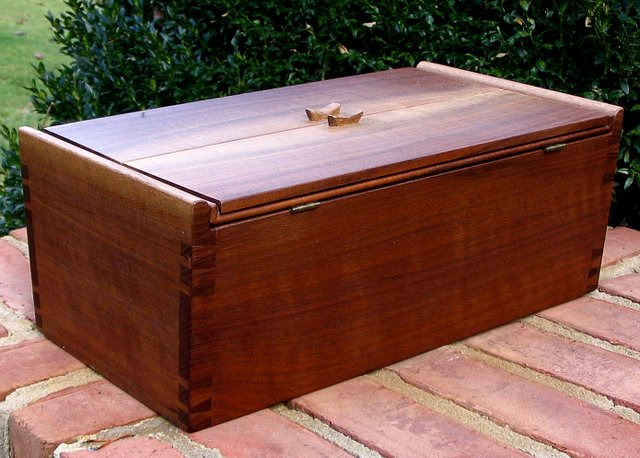
Chest For Medals, Circa 1980
Generally, a piece will arouse a pleasant memory like the people involved, where the wood came from, or how the design evolved. This piece however is remembered for a mistake. Near completion, a trim cut was made on the wrong side of a line. Surely the piece was ruined! At first there seemed no solution except to throw the chest away. But in the end, a fix was devised and things worked out just fine.
Subsequently the chest has come to evoke a more powerful reaction. It is in the possession of someone that uses it to hold a lifetime of awards and medals. Quite an honor for a piece of woodworking.
|
Walnut Showcase Cabinet
|
Walnut Showcase Cabinet, December 1980
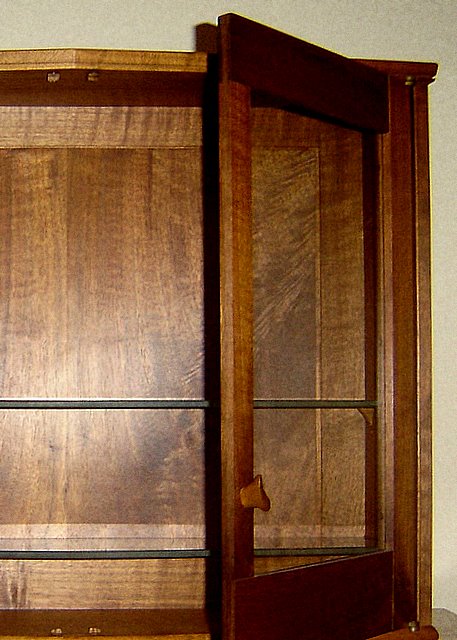
This cabinet was an early speculative piece. Fascinated by a highly figured plank cut from the crotch of a very old walnut tree, a design was developed to highlight what would be a particularly striking back panel. Made from two thin bookmatched pieces, the back panel was rough-cut first. With the panel cut all of the rest of the pieces, back frame, cabinet top and bottom, cabinet sides, and the doorframe pieces, were all carefully cut and sized with the panel in mind. Construction began with the cabinet top, bottom, and sides. They were shaped and joined into their final form. Next came the doors, made from their unique sets of bookmatched pieces. And finally work on the back panel, the inspiration for the cabinet, began. All went well until the edge of the panel was being machined. And then...unh, the end of one edge of the panel drifted up into the cutter, ruining the tongue and the panel. Without that panel the whole cabinet would not be the same. What to do? To fix it would require a very risky operation that consisted of cutting off the spoiled tongue from all four edges and then machining a groove for a spline in the edges of the thin panel. Not until the fix was successful was a relaxed breath taken. Now, more than twenty-five years later, two things are remembered about the cabinet, the fix and the good friend that owns it.
|
Walnut Cabinet with Flower Pulls
|
Walnut Cabinet with Flower Pulls, June 1980
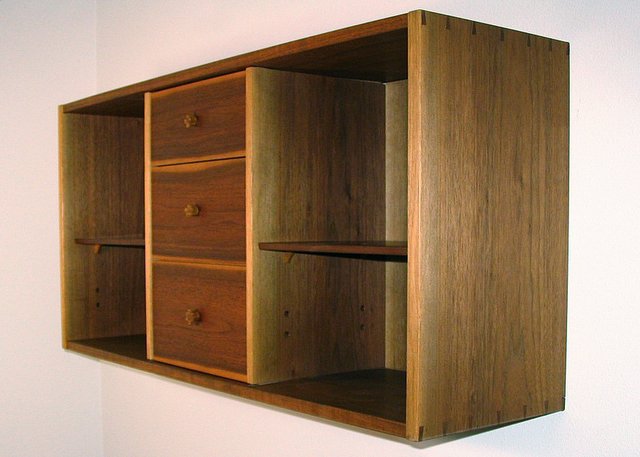
Two thick walnut planks and a bit of oak were fashioned into this cabinet. One plank, with distinctive sapwood along both edges, was from a small tree. It was resawn to yield three drawer fronts each taller than the preceding one. These drawer fronts were then stacked to form the center section of the piece. The larger plank was resawn into the pieces for the back panels and the carcass with careful consideration given to the inclusion of sapwood. Though a pleasant composition, the cabinet needed something. Flower drawer pulls seemed to finish it up. When done, the piece seemed a good match for the client, a pleasant, interesting, and cheerful woman.
|
Cherry Lap Desk
|
Cherry Lap Desk, May 1980
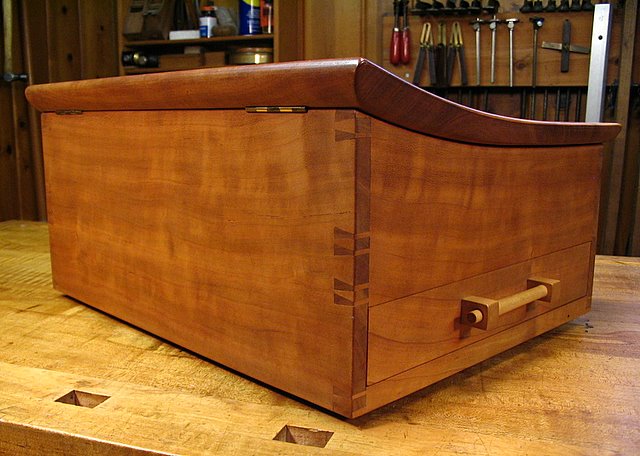
Many lap desks have slanted tops. While imagining what it would be like to use one, it seemed that a top with a gentle curve that flattened out as it approached the writer would be more comfortable. That simple thought shaped the design of this lap desk. A thick plank of cherry was sawn and resawn into the parts for the case with an ivory white maple used for the drawer's handles, sides, and bottom. Destined to be the graduation present for a good friend there are fond recollections of meetings about the design, building the desk, and the day it was picked up. And looking now at pictures sent to the Basement Workshop twenty-five years later there is sense of gratitude for past work and continued friendship.
|
A Wall Box for Butch
|
A Wall Box for Butch, December 1979
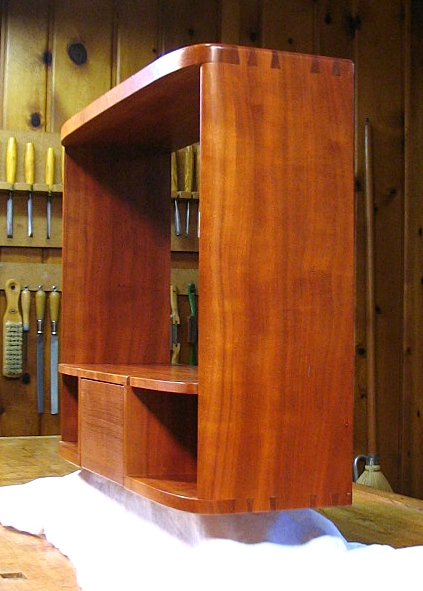
A kind friend told me that he would like to have something that had been made in the Basement Workshop. At the time, my friend had a very distinctive look. His sideburns and moustache rivaled those of a Civil War general and his cheeks were like Saint Nick's. In short order, the outline of his moustache had been translated into an across-up-across-down-across pattern for the front edge of a pair of shelves. As details emerged they took on a distinctly rounded theme consistent with my friend. When finished, the piece was spontaneously named the "Butch Box" because it was a furniture caricature of my friend Butch. Another memory contributes to my fondness for this wall shelf. Delightfully, my friend who has been known to dress as Santa Claus, was an answer to prayer. You see this little shelf was made in time to provide for a young family's Christmas.
|
Rounded Walnut Coffee Table
|
Rounded Walnut Coffee Table, December 1979
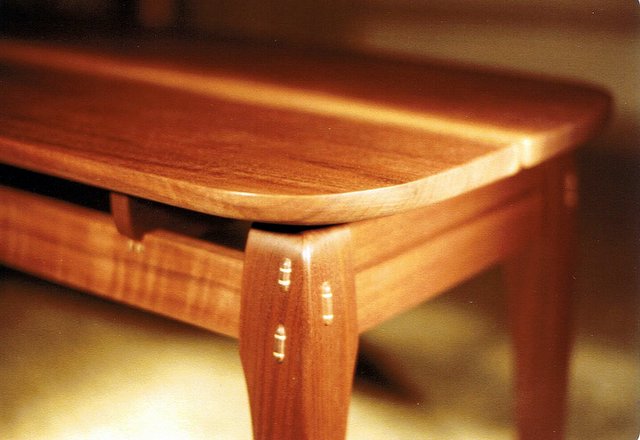
The assignment for this table came from an acquaintance I made while taking a class. The young father wanted a coffee table for his family room. He liked walnut and there were active children to be considered. Using some walnut that had been harvested off of an estate on Long Island, the top was fashioned by resawing a thick plank of that wood and turning the sapwood edges toward the center. Next a leg was designed that would be stout enough for family use. And finally, all of the rounded details were developed while imagining the children running around and bumping into the table.
|
Asymmetrical Ash Cabinet
|
Asymmetrical Ash Cabinet, July 1979
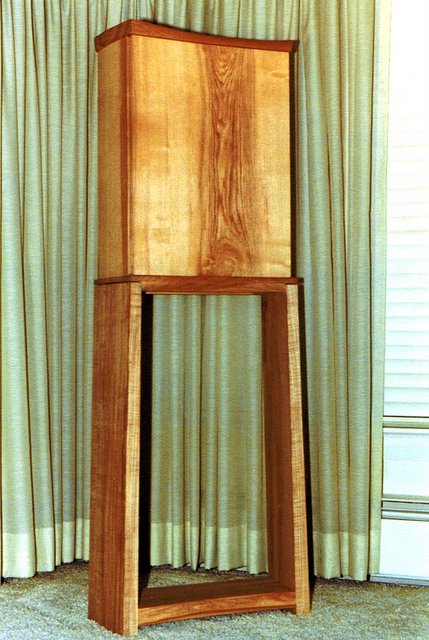
Two distinctly different ash planks, some quartersawn oak, and a few bits of teak were used in this standing cabinet. The door, cabinet sides, and interior shelves, all came from the first ash plank. It had heartwood that contrasted nicely with the sapwood and a fine texture. Exploiting the effect of light and dark, a coopered door with an uneven curve was fabricated. The heartwood that ran from top to bottom and was positioned right of center served as the axis. The rest of the details and grain effects of the cabinet were derived from the door. The ash for the base was less delicate and was purchased following a far-flung wood hunting expedition that almost reached to another state. This cabinet was displayed in a gallery and did not come back to the Basement Workshop. Curiosity still lingers about the cabinet's whereabouts.
|
Manzanita and Mahogany Box
|
Manzanita and Mahogany Box, March 1979
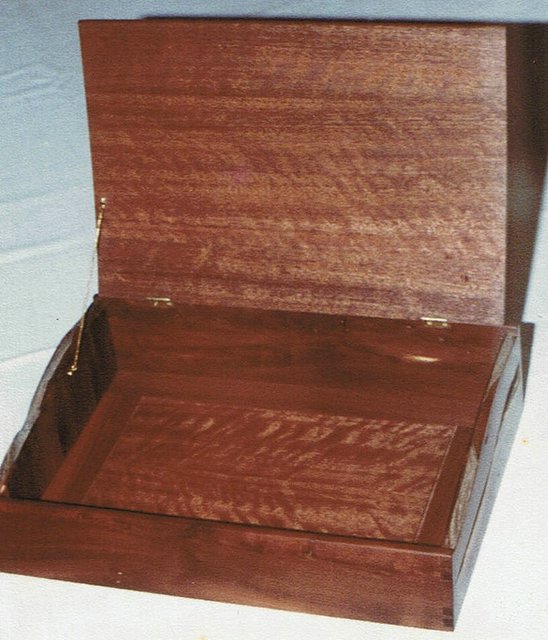
When asked to make a jewelry box out of a piece of manzanita that was meaningful to a friend's relative, the answer was, "Sure!" But the piece of wood turned out to be little more than a stick. Pressing forward, the wood was resawn. There was enough to glue together to make the front and back of the box, but not enough for the sides. The solution was to add small paneling strips to the inside of the sides. The rest of the box as well as the paneling were all made of mahogany. When the box was completed, there was hardly any manzanita scrap.
|
Tea Table
|
Tea Table, circa 1978
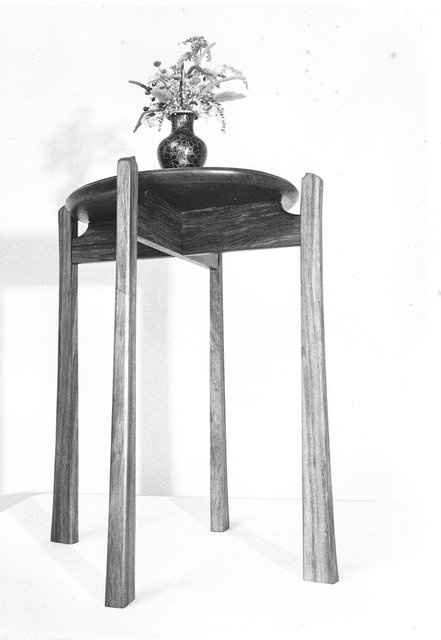
A lot of the wood in the Basement Workshop was purchased from a company, located in southern Maryland, that has since gone out of business. One day, the proprietor showed me a small slice of madrone burl. Throughout construction of the table, the distinctive burl informed design decisions and was fashioned into the top. Unfortunately, none of the pictures feature the burled top. The base was made from a piece of bubinga that was also bought from the old proprietor.
|
Tile Tables
|
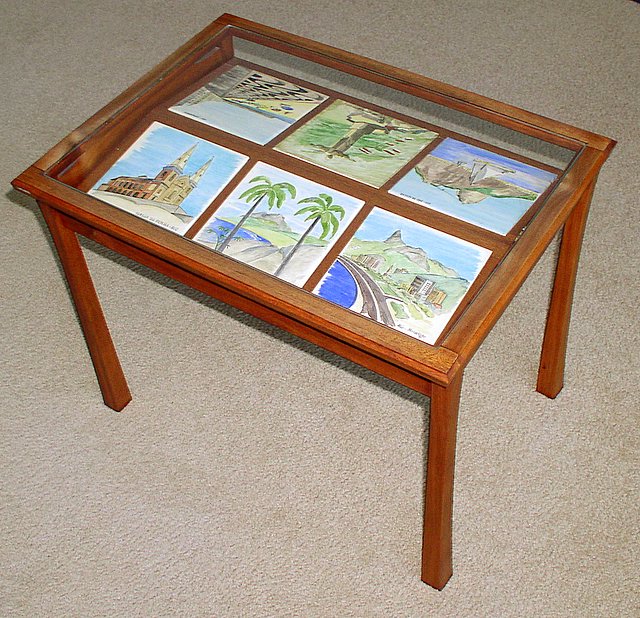
Tile Tables, July 1978
A friend from work wanted to display a dozen tiles. She wondered if they could be set into a pair of tables that would show off the tiles to their best advantage. So that they could be seen easily, the tiles were set in angled mahogany frames that rested upon the long side stretchers. The end stretchers were designed with an upward curve and held the tabletop floating above the rest of the table. Other than the frame for the tiles, the tables were made out of bubinga a hard, tough, tropical wood that accentuated the slender legs. This project was among the first built for others. Looking back, her trust was remarkable.
|
.jpg)
Walnut Cabinet
|
Walnut Cabinet, circa 1977
This cabinet was made as a serious interest in woodworking grew into a surprisingly compelling calling. Motivated and inspired by the superior cabinetmaking in "A Cabinetmaker's Notebook," the design of this piece began by working a board with an interesting crotch figure into the door of the cabinet. Planing a curve into the door, cutting a proper set of dovetails, and building a neat frame and panel for the back of the cabinet were among the sound cabinetmaking techniques tried for the first time.
|
Lot Vexed and Mourning
|
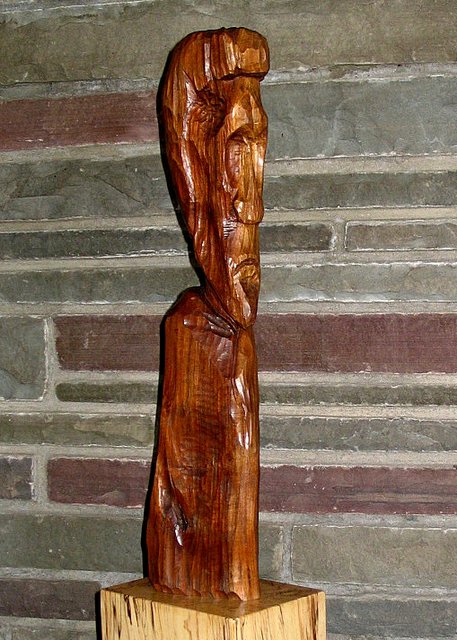
Lot Vexed and Mourning, Circa 1976
Though the Old and New Testaments speak most hopefully of a God that has taken all necessary steps for anyone to enter into His rest, they also speak clearly that we live in a world scarred and distorted by the falling short of every one of us. Reflecting on this worldview inspired this carving of Lot, a man that was vexed by the atrocities committed around him and acquainted with difficult loss. The walnut for the carving and the maple for the base were both salvaged from firewood.
|